About HPA
The purpose of the Houston Psychological Association (HPA) is to promote the development of psychology as a science and profession. HPA provides psychologists opportunities for professional growth and association with other psychologists. It serves to foster constructive relations with allied professionals and to promote ethical standards for psychological practice. HPA offers consumers an information and referral service to facilitate contact with qualified psychologists and a speaker’s bureau to address community concerns. HPA is dedicated to fostering responsible community ties.
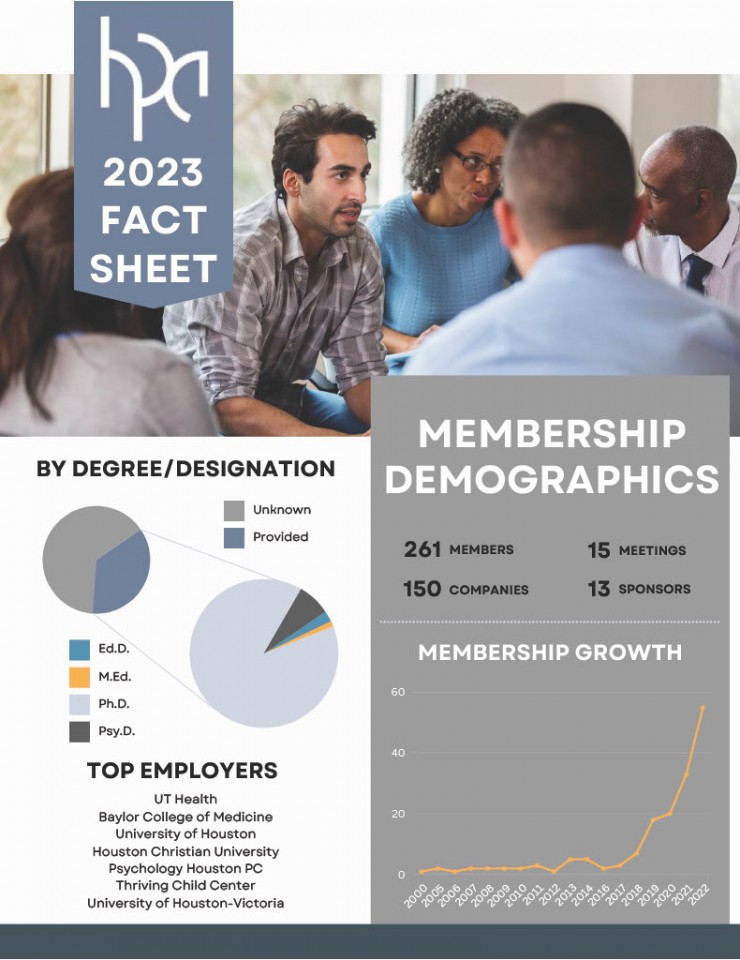
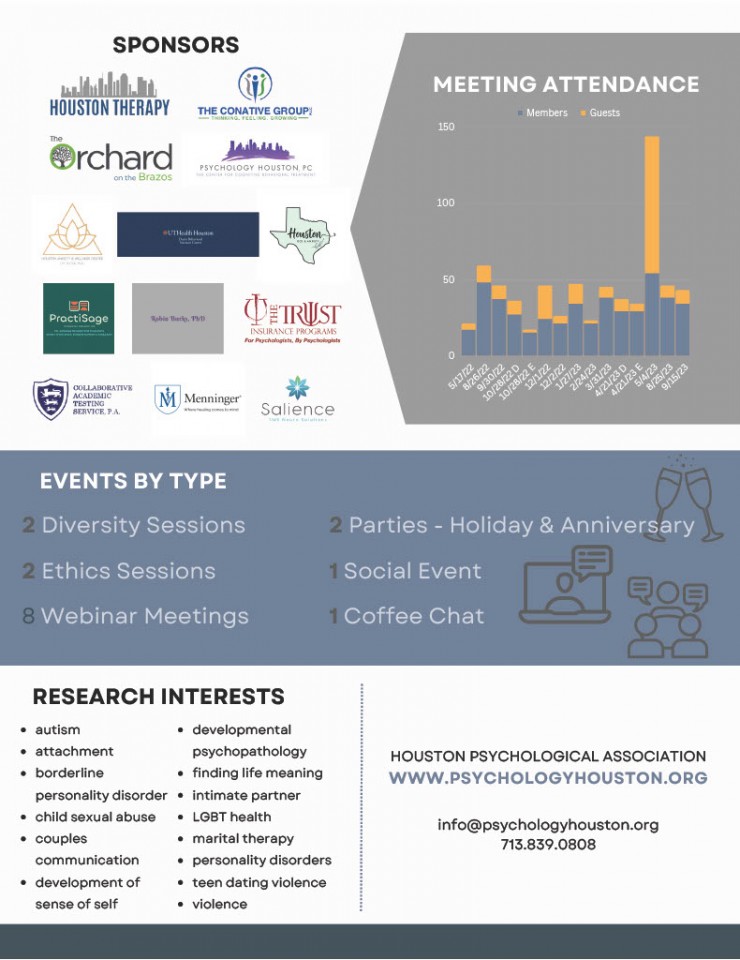
More than 200 greater Houston area psychologists trained in Counseling, Clinical, Educational, Neuro-, Industrial/Organizational, and School Psychology find this organization useful to keep abreast of current evidence based practices as well as legal and professional issues. HPA meets periodically for social and professional development activities germane to the professional work of psychology. Regular monthly meetings that include 1.5 - 3.0 hours of professional development from invited speakers and are held either on ZOOM or in person.
DEI Committee Mission:
The Houston Psychological Association (HPA) is committed to promoting social justice and anti-oppression by striving to cultivate an atmosphere of safety, equity, and belonging by welcoming and affirming psychologists and psychology trainees whose unique heritages, life experiences, and identities represent the rich tapestry of human diversity. This includes, but is not limited to, (dis)ability status, gender identity, gender expression, national origin, neurodivergence, race/ethnicity, age, religious beliefs, socioeconomic status, and sexual orientation.
Our commitment rests on the conviction that our differences are our strengths and will help us achieve our organizational vision of diversity, equity, inclusion, and intersectionality. In doing so, we aim to encourage membership, recruitment, and retention of members that reflect the true diversity of Houston psychologists, psychology trainees, and the communities we serve. We aim to promote respectful dialogue around the dynamics of privilege and oppression. In doing so, the DEI committee aims to uplift the voices of those who are disenfranchised and who experience the intersections of multiple oppressions.
We call on our members to be active allies by continuously examining implicit and explicit biases within themselves, pursuing culturally responsive education and training with intent, and building supportive relationships with historically excluded communities. Our hope is that HPA members understand the impact of social injustices on marginalized communities and incorporate this into our professional work and within our various communities.
As an organization that works to create a welcoming and inclusive environment, HPA has a zero-tolerance policy towards any discrimination or mistreatment of any individual who comes into contact with our organization due to their (dis)ability status, gender identity, gender expression, national origin, neurodivergence, race/ethnicity, age, religious beliefs, socioeconomic status, sexual orientation, or any other form of bias. Our zero-tolerance policy extends to all HPA members, staff, and any community members we serve.
Aspirational Values:
Our aspirational values help guide our efforts to live out our mission and DEI statements. These values are rooted in courage, curiosity, compassion, accountability, awareness, and authenticity. We recognize that diversity, equity, inclusion, and intersectionality will bring forth differing perspectives to help our members grow in new ways. Our hope is that HPA members will find safety and freedom to show up as their whole selves. A self that is not required to code switch, please, or accommodate to the environment around them.
Our mission will be focused around these goals:
- Lead by example
- Explore with humility and compassion
- Inspire belonging
- Using our voice within HPA and our Greater Houston community
- Seek and model social justice
- Educate ourselves on and invite productive conversations about topics of diversity, equity, inclusion, and intersectionality
- Actively engage in allyship
In solidarity, the DEI Committee Members:
Dr. Jenny Hughes
Dr. Ally Sequeira